Skip to content
Choosing the right power source can shape your business’s reliability, operating costs, and ability to grow. A poor decision may cause frequent downtime, damaged equipment, or unexpected fuel expenses. The choice deserves more than a quick price comparison.
Dr. M. Stanley Whittingham, a Nobel Prize-winning battery scientist, explains, “The battery is a device that stores chemical energy and converts it into electrical energy.” His point highlights an important reality: every power source has limits. Batteries may offer quiet backup power and fast response, while generators can support longer outages. Solar systems can reduce grid dependence, but weather and installation space matter. Grid electricity may seem simple, yet tariffs and local reliability can change the calculation.
Start with your actual operating conditions. Record your peak load, daily energy use, critical equipment, and acceptable downtime. A small workshop may need a compact battery system for computers and security devices. A cold-storage facility may require generator capacity, automatic switching, and fuel planning. Check voltage quality, maintenance access, noise limits, and future expansion. These details often matter more than a brochure’s headline capacity.
There is no perfect answer.
A reliable power source should match your risk, budget, and workflow. Total cost includes installation, maintenance, replacement, training, and disposal. It is easy to overlook the last two. Businesses should also compare supplier warranties, service networks, safety certifications, and performance data from similar sites. One weakness remains: forecasts are never perfect. Review your assumptions annually, because energy prices, equipment loads, and business priorities change. The smartest decision is not always the cheapest option today. It is the option that keeps your operations dependable tomorrow.
Choosing a power source begins with a measured definition of your business’s electrical needs. List every load, including motors, refrigeration, servers, lighting, and safety systems. Record normal wattage, starting surges, operating hours, and acceptable downtime. A motor may briefly demand several times its running power. Ignoring this detail can cause nuisance shutdowns.
Operating conditions matter just as much. Note indoor temperature, humidity, dust, altitude, flooding risk, and available ventilation. A generator sized for a cool warehouse may perform poorly in a hot, enclosed room. The U.S. Energy Information Administration reported that weather-related disruptions remain a major contributor to electricity interruptions in the United States. Grid dependence therefore deserves a realistic contingency plan. Not just optimism.
Critical loads should be separated from flexible loads. Hospitals, cold storage sites, and data processing rooms may require automatic transfer, battery support, or parallel generation. The International Energy Agency estimates data centres consumed about 240 terawatt-hours globally in 2022, showing how quickly concentrated digital workloads can influence energy planning. Uptime Institute’s Global Data Center Survey also continues to identify power problems among leading causes of serious outages. These findings support practical testing: measure peak demand, simulate startup events, and inspect fuel autonomy. A spreadsheet can look precise, yet it may hide seasonal changes, future expansion, or poor power quality. Recheck the assumptions with an electrician and actual site measurements.
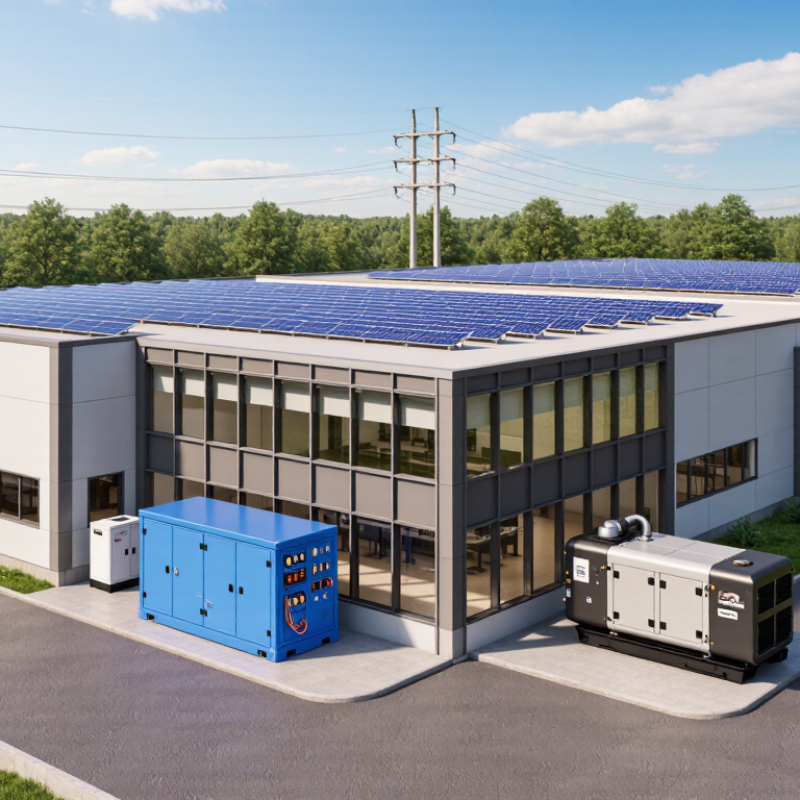
Choosing a business power source starts with load patterns, outage risk, and site conditions.
Grid electricity is usually the simplest option, especially for stable urban connections. However, tariffs, peak charges, and interruptions can damage operating margins. Generators provide rapid backup for hospitals, workshops, and cold storage. They need fuel logistics, testing, ventilation, and regular maintenance. A generator is not automatically cheap.
Solar can reduce daytime purchases and price exposure. The International Energy Agency reported that solar represented about three-quarters of global renewable capacity additions in 2023. Yet solar output falls during cloudy afternoons and stops after sunset. Batteries can shift solar energy into evening demand. BloombergNEF reported that average lithium-ion battery pack prices reached about 115 dollars per kilowatt-hour in 2024. Real project costs remain higher after controls, installation, and safety systems. Hybrid systems combine grid, solar, batteries, and sometimes generators. They offer resilience, but controls can become difficult to manage.
Tips:
Measure fifteen-minute loads before choosing equipment. Separate essential circuits from flexible loads. Ask for outage records, tariff schedules, fuel delivery times, and battery warranty conditions. Model winter solar production, not just annual averages. The National Renewable Energy Laboratory’s PVWatts tool can support an initial estimate, but it is not a bankable study. A spreadsheet may look precise and still miss transformer limits or startup surges. Review the design with a qualified electrical engineer and local safety authority. Small businesses often overbuy storage; larger sites may underestimate control complexity. There is no universal winner.
How to Choose the Right Power Source for Your Business?
Choosing a business power source requires more than comparing monthly bills. In site assessments, I have seen low purchase prices hide costly installation and maintenance demands. Calculate equipment, fuel, inspections, repairs, insurance, and disposal expenses. Include the cost of production losses during outages. A detailed five-year estimate often reveals unexpected differences. Request written quotes and question unclear assumptions. Small details matter.
Reliability depends on outage frequency, repair access, weather exposure, and backup options. Ask how quickly service can be restored after a failure. Review local outage records, not only supplier claims. Capacity also requires careful measurement. Record actual demand for several weeks, including seasonal peaks and motor starting surges. Our first estimate was wrong because a cooling system started at full load. That mistake could have caused repeated shutdowns. Leave room for moderate growth, but avoid excessive capacity. Oversized systems may waste money and operate inefficiently.
Environmental impact extends beyond direct emissions. Compare fuel consumption, carbon intensity, water use, noise, transport, and equipment lifespan. Request credible lifecycle data when available. A low-emission system may still involve energy-intensive manufacturing or difficult disposal. Set practical targets, such as reducing fuel use by a measured percentage each year. Keep maintenance and consumption records. Review them regularly. No option is perfect. Conditions change, and assumptions need honest revision.
Comparative benchmark of cost, reliability, capacity, and environmental impact. Higher scores indicate a more favorable business profile.
The 0–100 scores are normalized from representative utility-scale ranges for levelized electricity cost, typical capacity factor, operational dependability, and lifecycle greenhouse-gas emissions. Costs and emissions receive higher scores when they are lower, while reliability and capacity receive higher scores when they are higher. Actual results vary by location, project design, fuel prices, grid connection, and financing.
How to Choose the Right Power Source for Your Business?
A power source should fit your building, workload, and risk profile. Start with a measured load assessment, not a rough estimate from an old invoice. Record normal demand, startup surges, and critical equipment. A refrigeration unit may draw modest power, then spike sharply when its compressor starts. I have seen businesses overlook this detail. The result was nuisance shutdowns during busy hours.
Check recognized safety standards before comparing purchase prices. Ask for independent test certificates, installation records, and protection details. Confirm grounding, overload protection, ventilation, noise limits, and emergency isolation points. A qualified electrician should inspect the proposed setup and review the site conditions. Small faults matter. Warm cables, blocked vents, or poor connections can become expensive hazards.
Maintenance needs should be practical for your staff. Review service intervals, replacement parts, inspection access, and technician availability. Keep clear logs for testing, repairs, battery condition, fuel quality, or filter changes. Regulatory requirements also vary by location and industry. Confirm permits, emissions rules, workplace safety duties, fire controls, and electrical inspection schedules with the relevant authority. Do not rely only on a supplier’s checklist. It may miss a local requirement. I would also test the system under realistic conditions, although many companies postpone this step until failure exposes the weakness. Reliability is demonstrated through records, inspections, and repeated performance checks.
| Power Source | Typical Business Use | Typical Output and Runtime | Key Safety Standards and Controls | Typical Maintenance Needs | Regulatory Requirements to Check | Main Selection Consideration |
|---|---|---|---|---|---|---|
| Utility Grid Supply | Primary power for offices, retail facilities, warehouses, and manufacturing sites. | Continuous supply subject to grid capacity, outages, and service limitations. |
Electrical protection Grounding, overcurrent protection, short-circuit protection, arc-flash assessment, and safe isolation procedures. |
Periodic inspection of switchgear, circuit breakers, distribution boards, protective relays, and earthing systems. Testing intervals depend on the equipment and risk assessment. | Local electrical codes, utility interconnection rules, building regulations, and workplace electrical-safety requirements. IEEE 1547 may apply to distributed-energy interconnections in some jurisdictions. | Best for low on-site maintenance, but a backup source may be necessary where outages affect operations. |
| Diesel Generator | Emergency backup for critical loads, construction sites, data rooms, healthcare facilities, and industrial operations. | Commonly available from approximately 10 kW to several MW. Runtime depends on fuel-tank capacity and load; larger tanks can support multiple days of operation. |
Standby power safety NFPA 110 or equivalent emergency-power requirements, NFPA 70 electrical rules, grounding, exhaust ventilation, fuel containment, fire protection, and lockout/tagout procedures. |
Routine inspections, battery checks, coolant and oil checks, fuel-quality management, filter replacement, load-bank testing, and periodic start-up tests. Oil and filter service is often required every 250–500 operating hours, subject to the equipment manual. | Local air-emissions permits, fuel-storage rules, fire codes, noise limits, environmental reporting, and workplace safety regulations. Emissions requirements vary by location and generator size. | Strong long-duration backup capability, but fuel storage, emissions, noise, and regular engine maintenance must be managed. |
| Natural Gas Generator | Standby or prime power where pipeline gas is available and lower on-site liquid-fuel storage is preferred. | Commonly available from approximately 20 kW to several MW. Runtime can be long while the gas supply remains available, but pipeline interruptions may affect operation. |
Gas and electrical safety NFPA 54 or equivalent fuel-gas requirements, NFPA 70, NFPA 110 where used for emergency power, gas-leak detection, ventilation, automatic shutoff, and exhaust controls. |
Engine inspections, spark-plug or ignition-system service, oil and filter changes, coolant checks, battery tests, and periodic load testing. Service intervals vary by engine design and operating hours. | Gas-piping permits, air-emissions limits, building and fire codes, utility requirements, noise controls, and emergency-generator regulations. | Convenient for sites with reliable gas infrastructure; less suitable where gas supply continuity is uncertain. |
| Battery Energy Storage System | Peak shaving, short-duration backup, renewable-energy storage, power-quality support, and fast load transfer. | Common commercial systems range from tens of kWh to multiple MWh. Typical backup duration is minutes to several hours, depending on battery capacity and load. |
Thermal-event control NFPA 855, UL 9540, UL 9540A or equivalent, battery-management systems, thermal monitoring, ventilation, emergency shutdown, separation distances, and fire-response planning. |
Continuous remote monitoring, inspection of battery modules and cooling systems, firmware and protection checks, capacity testing, and replacement of degraded modules or auxiliary components. | Electrical and fire-code approvals, planning and zoning rules, emergency-response requirements, hazardous-material procedures, recycling or disposal obligations, and utility interconnection requirements. | Excellent response speed and low routine mechanical maintenance, but upfront cost, thermal safety, degradation, and end-of-life planning are important. |
| Solar Photovoltaic with Battery Storage | On-site renewable generation, energy-cost reduction, resilience for offices, retail sites, farms, and light industrial facilities. | Solar output varies with sunlight, season, shading, and system size. Batteries commonly provide several hours of backup when sized for the critical load. |
DC and rooftop safety NEC Article 690 or equivalent, IEC 62548, IEC 62446-1, DC isolation, rapid shutdown where required, arc-fault protection, roof access controls, and battery safety standards. |
Panel inspection and cleaning where soiling is significant, inverter checks, wiring and mounting inspections, vegetation control, performance monitoring, and battery-system service. | Building and electrical permits, structural review, fire-access rules, utility interconnection approval, export limitations, net-metering or tariff requirements, and battery-storage regulations. | Reduces grid energy use and emissions, but output is variable and sufficient battery capacity is needed for reliable backup. |
| Fuel Cell System | Continuous or distributed generation for facilities requiring high availability, low local emissions, or combined heat and power. | Often configured from tens of kW to several MW. Can operate continuously when fuel infrastructure is available. |
Fuel and process safety NFPA 853 or equivalent stationary fuel-cell safety requirements, electrical protection, hydrogen or fuel-gas detection, ventilation, pressure controls, and emergency shutdown systems. |
Filter and air-system checks, water or thermal-system checks, sensor calibration, software diagnostics, stack-performance monitoring, and periodic specialist servicing. | Building and fire permits, fuel-gas or hydrogen rules, air-emissions requirements, pressure-vessel regulations where applicable, electrical interconnection approval, and environmental permits. | Suitable for high-utilization sites with dependable fuel supply; specialist maintenance and higher capital costs should be considered. |
| Uninterruptible Power Supply | Short-term continuity for servers, telecommunications, medical equipment, control systems, and sensitive electronic loads. | Commonly sized from a few kVA to several hundred kVA. Battery runtime is typically measured in minutes, although additional battery cabinets can extend it. |
Power-quality protection IEC 62040 or equivalent UPS requirements, electrical isolation, battery-room safety, overcurrent protection, bypass protection, and monitoring of temperature and battery condition. |
Regular self-tests, battery impedance or capacity tests, cooling-system inspections, alarm checks, firmware updates, and battery replacement commonly within a multi-year lifecycle based on chemistry and conditions. | Electrical permits, battery-storage and fire-code requirements, workplace safety rules, disposal or recycling requirements, and data-center or critical-facility standards where applicable. | Best for preventing interruptions and voltage disturbances, but it normally needs a generator or other source for extended outages. |
Choosing a power source starts with your actual operating pattern, not a brochure’s promised output. Walk through the facility during its busiest hour. Record motors, refrigeration, servers, lighting, and equipment that starts suddenly. A basic power meter can reveal demand spikes that monthly utility bills hide. I have seen an apparently adequate system fail when several compressors started together. That mistake was expensive. It also delayed production.
Select the source according to risk, not fashion. Grid power may suit stable operations with reliable local service. Solar generation can reduce daytime costs, while batteries may support sensitive equipment during interruptions. A fuel-based generator can provide longer backup, but it needs ventilation, regular servicing, safe fuel storage, and noise controls. Review installation rules, electrical codes, and workplace requirements with qualified professionals. Capacity calculations should include future equipment, starting loads, and realistic downtime expectations.
Implementation should begin with critical circuits. Keep medical equipment, security systems, network devices, or refrigeration separate from nonessential loads. Use certified transfer equipment and have a licensed electrician inspect every connection. Test the system under load, not only during a quiet demonstration. Schedule inspections, battery checks, fuel testing, and emergency drills. Plans often look complete on paper. They are not always practical at 2 a.m. when one alarm fails and staff cannot find the manual. Leave clear labels, printed procedures, and a contact list near the control panel.