How to Understand Electrical Circuit Design and Its Applications?
Electrical circuit design forms the backbone of modern technology. An electrical circuit is an interconnected path that allows the flow of electric current. Understanding its design requires both theoretical knowledge and practical experience.
In this guide, we will explore the fundamentals of electrical circuits. We will discuss various components such as resistors, capacitors, and inductors. Each plays a crucial role in circuit functionality. Designing a circuit is not simply about connecting parts; it requires a deep understanding of their interactions.
Many encounter difficulties in circuit design due to a lack of hands-on experience. While textbooks provide essential knowledge, real-world applications offer valuable lessons. Mistakes in design can lead to circuit failures, highlighting the need for careful planning. Embracing these challenges strengthens our skills and enhances understanding in electrical circuit design.

Understanding the Basics of Electrical Circuit Design Principles
Understanding electrical circuit design principles is crucial for engineers and hobbyists alike. Circuit design involves the creation of pathways that electrical currents follow. These pathways can power devices, control systems, or even facilitate communication. According to a report from the International Energy Agency, efficient circuit design can improve energy use by up to 30%. This highlights the importance of understanding and applying fundamental design principles effectively.
Basic concepts such as Ohm’s law, Kirchhoff's laws, and basic components like resistors, capacitors, and inductors form the foundation of circuit design. A deeper grasp of these principles leads to innovative solutions and improved functionality. A survey conducted by the Institute of Electrical and Electronics Engineers reveals that almost 60% of circuit design flaws could have been avoided with better initial understanding. Yet, many engineers overlook the significance of these basics, leading to costly errors or inefficient systems.
In practice, one must consider factors like load calculations, voltage drops, and safety margins. Often, designs fail not due to a lack of knowledge but because of neglecting critical details. It is essential to continuously review and refine designs, learning from both successes and failures. Circuit design is a continuous journey, where understanding core principles can lead to better applications across various fields.
Key Components of Electrical Circuits and Their Functions
Electrical circuits are fundamental to modern technology. Understanding their components is crucial for effective design. Key components include resistors, capacitors, inductors, and diodes. Each plays a unique role. For example, resistors manage current flow. Capacitors store energy temporarily. According to a recent industry report, more than 40% of circuits in electronic devices utilize these components for efficiency.
Inductors are another important element. They oppose changes in current, maintaining stability in circuits. Diodes ensure current flows in one direction, protecting sensitive components. In systems that demand precision, selecting appropriate components is vital. A study found that incorrect component choices can reduce efficiency by up to 25%. Designers must balance cost, performance, and reliability.
It’s important to note that not all circuit designs succeed on the first try. Prototyping often reveals flaws. Engineers must adapt designs based on testing results. This iterative process is essential in developing robust applications. Ultimately, experience and careful analysis guide successful electrical circuit design.
Understanding Key Components of Electrical Circuits
This bar chart illustrates the number of applications for key components of electrical circuits, including resistors, capacitors, inductors, diodes, and transistors. Understanding these components is essential for effective circuit design and their applications in various fields.
Types of Electrical Circuits and Their Typical Applications
Electrical circuits are fundamental to modern technology, and understanding their types expands their potential applications. The main types include series, parallel, and series-parallel circuits. A series circuit connects components end-to-end, ensuring that current flows through each component sequentially. This design is often used in simple applications like string lights. One drawback is that if one component fails, the entire circuit stops working.
Parallel circuits, on the other hand, allow multiple paths for current flow. This is ideal for household electrical systems. A common example is the wiring in homes, where if one bulb burns out, others remain lit. Data from the International Electrotechnical Commission shows that effective parallel circuit designs can improve energy efficiency by up to 30%. However, improper design can lead to voltage drops and unpredictable behavior.
Series-parallel circuits combine both types, balancing advantages and drawbacks. They offer flexibility in design but require careful planning. For instance, using them in computer circuits can enhance reliability. Yet, complexity increases with more components, leading to potential miscalculations. As technology advances, understanding these circuits’ nuances becomes vital for engineers and technicians alike.
Analyzing Circuit Behavior: Ohm's Law and Kirchhoff’s Rules
Understanding circuit behavior is essential for effective electrical circuit design.
Ohm's Law is fundamental. It states that
current equals voltage divided by resistance. This simple relation forms the backbone of many
circuit calculations. According to industry research, approximately
80% of circuit-related failures can be traced
back to inadequate understanding of
Ohm's Law. This underscores the need for engineers to
master the basics.
Kirchhoff’s Rules add another layer of understanding.
Kirchhoff’s Voltage Law states that the sum of all voltages
in a closed circuit equals zero. Similarly,
Kirchhoff’s Current Law emphasizes that total current
entering a junction equals total current leaving. These principles are critical for analyzing
complex circuits. A recent report from the
International Electrotechnical Commission noted that
65% of circuit simulation errors arise from miscalculations using
these rules. This highlights the importance of diligent application.
The real world often complicates these laws. Variations in material quality and environmental
factors can affect circuit behavior. In practice, engineers need to adjust calculations based on
these variables. Despite having theoretical knowledge, practical application can lead to errors.
Continuous learning and adaptation are essential for success in circuit design.
Real-World Applications of Electrical Circuit Design in Technology
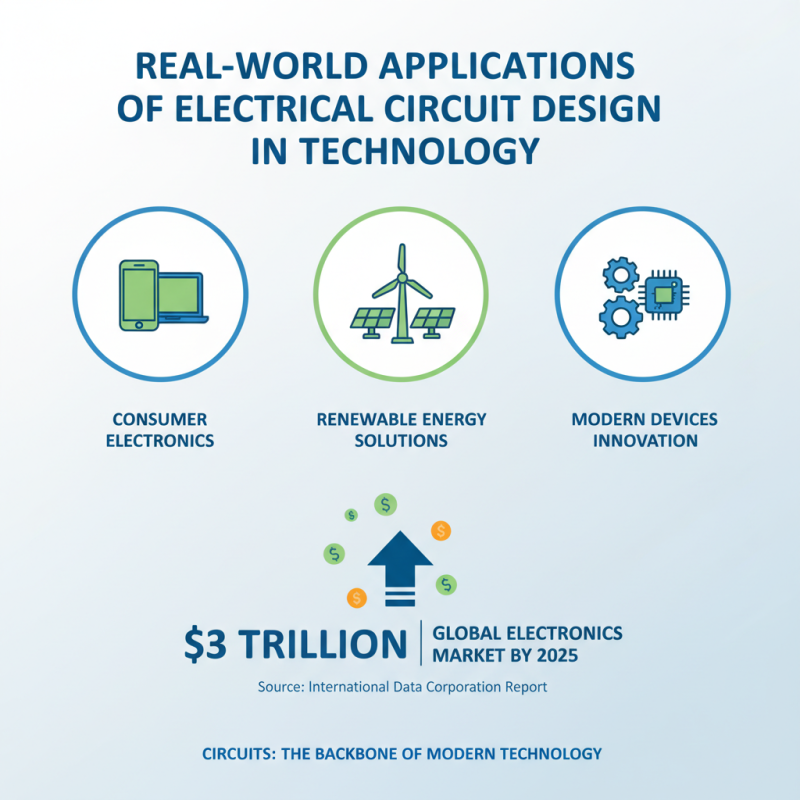
Electrical circuit design plays a crucial role in various technological applications. From consumer electronics to renewable energy solutions, circuits are the backbone of modern devices. According to a report by the International Data Corporation, the global electronics market is projected to reach $3 trillion by 2025. This growth underscores the significance of circuit design in driving innovation.
In automotive technology, circuit design is integral. Electric vehicles (EVs) rely on complex circuits for battery management, power distribution, and regenerative braking systems. A study by the IHS Markit noted that EV sales are expected to hit 31 million globally by 2030. This surge highlights the need for efficient and reliable circuit designs to enhance performance and safety.
Health technology also benefits from advanced circuit design. Medical devices, such as pacemakers and imaging equipment, require precise circuit layouts to function correctly. The MedTech industry is experiencing rapid growth, with an estimated value of $600 billion by 2025, according to Statista. However, maintaining reliability in circuit design poses challenges, such as component wear and electrical noise, which need continuous monitoring and refinement.
 Skip to content