 Skip to content

Top 10 Combined Harvester Manufacturers for Global Buyers
Choosing the right Combined Harvester is rarely a simple brand decision. Crop type, field size, terrain, labor availability, and dealer support can change the result dramatically. A machine that performs brilliantly in European wheat may struggle in humid rice fields or uneven maize land.
Dr. John Fulton, a precision agriculture specialist at The Ohio State University, has stated, “Data is becoming as important as horsepower in modern agriculture.” That observation matters to global buyers. Modern harvesters now combine powerful engines with yield sensors, GPS guidance, automation, and remote diagnostics. Yet technology alone does not guarantee value. Operators still judge a machine by clean grain samples, low losses, easy maintenance, and reliable performance during long harvest days.
This guide examines the Top 10 Combined Harvester Manufacturers for Global Buyers. It considers harvesting capacity, crop flexibility, fuel efficiency, cabin comfort, parts availability, dealer networks, and after-sales service. Total ownership cost also deserves attention. A lower purchase price may hide expensive filters, specialist repairs, or limited local support.
No ranking is perfect. Market conditions change, and buyer priorities differ. A family farm may prefer mechanical simplicity, while a large contractor may need fleet connectivity and high daily output. Product brochures can look impressive. Real field results matter more.
The manufacturers discussed here represent different strengths, technologies, and regional advantages. Their suitability depends on practical evidence, not reputation alone. Carefully comparing specifications, demonstrations, warranty terms, and local references can prevent an expensive mistake.
Combined Harvesters: Definition, Functions, and Global Market Role
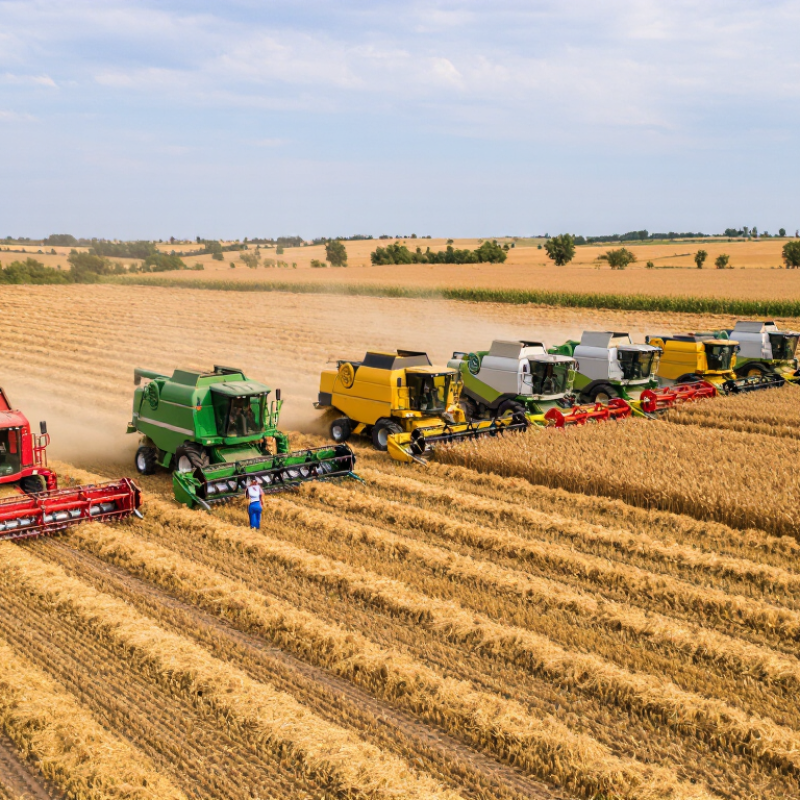
A combine harvester is a self-propelled machine that cuts, threshes, separates, and cleans grain in one field operation. Its header gathers standing crops, while the threshing unit removes kernels from straw. Sieves and airflow then separate usable grain from chaff. The machine stores grain temporarily before unloading it into a trailer.
Its global role is increasingly practical. The FAO’s 2024 Cereal Supply and Demand Brief estimated global cereal production at about 2.85 billion tonnes in 2023. That volume demands faster harvesting and lower field losses. A well-adjusted combine can reduce repeated passes, fuel use, and labor pressure during narrow harvest windows. However, performance depends on crop moisture, terrain, header width, and operator skill. Bigger is not always better.
Market reports reflect continued demand. Mordor Intelligence’s 2024 agricultural machinery analysis identifies labor shortages, farm consolidation, and precision agriculture as major growth factors for harvesting equipment. Modern combines may use yield monitors, satellite guidance, automatic speed control, and moisture sensors. These systems create useful data, but they do not replace field judgment. Dust, uneven crops, and poor calibration still cause losses. Global buyers should examine service access, spare-parts availability, grain damage rates, and total operating cost, not only engine power. The smartest specification can still fail without trained support nearby.
| Rank | Major Manufacturing Region | Primary Crop Applications | Typical Cutting-Header Width | Typical Grain-Tank Capacity | Common Harvester Configuration | Key Functional Strength | Global Market Role | Buyer Considerations |
|---|---|---|---|---|---|---|---|---|
| 1 | North America | Corn, soybeans, wheat, barley, canola | 6–12 m | 8,000–20,000 L | High-capacity wheeled and tracked units | High field productivity, large grain-handling systems, and advanced automation compatibility | Important source of large-scale harvesting technology for extensive farms and professional contractors | Best suited to large fields, high annual utilization, wide transport routes, and strong after-sales support networks |
| 2 | Western Europe | Wheat, barley, rapeseed, maize, field beans | 5–10 m | 7,000–15,000 L | Flexible high-efficiency machines | Precise cleaning, low grain loss, crop-change flexibility, and strong road-mobility design | Major technology center for efficient harvesting in mixed cropping systems and medium-to-large farms | Evaluate machine width, road regulations, fuel efficiency, slope performance, and local dealer coverage |
| 3 | China | Rice, wheat, maize, rapeseed, soybeans | 2–8 m | 3,000–10,000 L | Multi-crop and regional configurations | Adaptation to varied farm sizes, rice harvesting, and diverse field conditions | Large-volume market supporting mechanization across small, medium, and expanding commercial farms | Check wet-field capability, spare-parts availability, operator training, and compatibility with local crops |
| 4 | Brazil | Soybeans, maize, wheat, rice, cotton seed crops | 6–12 m | 8,000–18,000 L | Large-field tropical agriculture units | High throughput, residue management, and performance in warm-climate grain production | Strategic supply base for mechanized agriculture in South America and other tropical farming regions | Prioritize cooling systems, humidity resistance, residue handling, and service support during long harvest seasons |
| 5 | India | Wheat, rice, soybean, pulses, maize | 2–6 m | 2,500–8,000 L | Compact and versatile machines | Operational flexibility for fragmented holdings, cereal harvesting, and varied residue conditions | Key mechanization market where custom-hiring services help smaller farms access harvesting capacity | Compare purchase cost, fuel consumption, maneuverability, local repair skills, and financing options |
| 6 | Russia and CIS | Wheat, barley, sunflower, rapeseed, maize | 6–12 m | 7,000–16,000 L | Heavy-duty broad-acre units | Long operating hours, large-area coverage, and suitability for broad-acre cereal production | Important regional source and user market for extensive grain farms with short harvest windows | Assess cold-weather operation, ground clearance, durability, logistics, and parts availability over large distances |
| 7 | Argentina | Soybeans, wheat, maize, sunflower, barley | 6–12 m | 8,000–18,000 L | Broad-acre grain harvesters | Efficient harvesting across large farms with strong grain and oilseed capability | Regional hub for agricultural machinery use and harvesting services in the Southern Cone | Review performance in variable moisture, crop residue conditions, transport requirements, and contractor use |
| 8 | Japan | Rice, wheat, barley, soybeans | 1–3 m | 1,000–3,500 L | Compact rice-oriented machines | Manoeuvrability, low ground pressure, precise harvesting, and wet-field adaptability | Specialized source of compact harvesting solutions for intensive and fragmented farming systems | Focus on paddy-field traction, machine width, cleaning performance, operator ergonomics, and maintenance access |
| 9 | South Korea | Rice, wheat, barley, soybeans | 1–3 m | 1,000–3,500 L | Compact self-propelled units | Rice harvesting efficiency, compact dimensions, and operation in small or irregular fields | Specialized mechanization market for intensive crop production and small-field conditions | Verify local crop compatibility, wet-ground performance, parts supply, and operator-training requirements |
| 10 | Turkey | Wheat, barley, sunflower, maize, pulses | 4–8 m | 5,000–12,000 L | Mid-size cereal and oilseed units | Balanced capacity, straightforward operation, and suitability for mixed farm structures | Regional manufacturing and distribution base connecting European, Middle Eastern, and nearby markets | Consider terrain adaptability, harvest-season support, export parts logistics, and fuel efficiency |
Definition: A combined harvester, also called a combine harvester, integrates cutting, feeding, threshing, separation, cleaning, and grain collection in one self-propelled machine. Capacity figures are indicative market ranges for comparable machine classes, while the ranking reflects broad global manufacturing and market relevance rather than audited company sales.