How to Choose the Right Motor and Control System?
Choosing the right motor and control system begins with the machine’s real operating conditions. A catalog rating alone rarely tells the full story. Load weight, starting torque, duty cycle, speed range, ambient temperature, and available power all influence the decision. A conveyor moving boxes needs different behavior from a pump handling variable flow. The details matter.
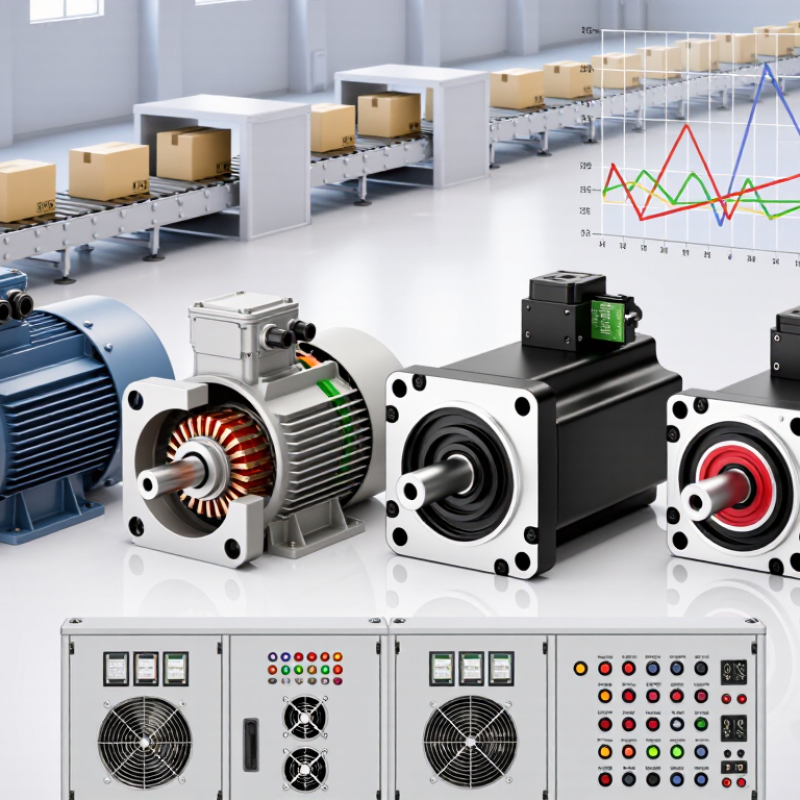
In practical equipment selection, engineers often compare induction, servo, stepper, and brushless DC motors. Each option has strengths and limitations. An induction motor may offer durable, economical operation. A servo motor can provide accurate position control and rapid response. A stepper motor may lose synchronism under unexpected loads. That weakness deserves attention.
The motor and control system must work as one design. A variable frequency drive can regulate speed, but it may not deliver precise positioning. A servo drive can provide feedback, yet it usually requires careful tuning and commissioning. Check voltage, current, overload capacity, communication protocols, braking needs, and enclosure ratings. Confirm these values against manufacturer documentation and relevant IEC or NEMA guidance.
Small tests reveal large problems.
A short bench trial can expose vibration, heat buildup, noise, or unstable acceleration. Measure actual current and temperature during representative cycles. Do not depend entirely on software simulations or sales claims. They help, but they are not proof. Even experienced teams can overlook maintenance access or future production changes. I have seen technically correct selections become poor investments because operators found the interface confusing. Reliable choices balance performance, safety, serviceability, energy use, and long-term cost. The best answer is rarely the most powerful motor.
Define the Application Requirements and Operating Conditions
How to Choose the Right Motor and Control System?
Define the Application Requirements and Operating Conditions
A reliable motor selection starts with the machine’s actual work, not a catalog speed. Record the required torque, speed range, acceleration time, duty cycle, and load inertia. Note whether the shaft starts under load or reverses frequently. A conveyor moving wet containers needs different protection from a clean, indoor positioning table. Small details matter.
I once selected a motor from rated power alone. That shortcut failed. The motor overheated during repeated starts, although its average load looked acceptable. Measure peak torque, continuous torque, and stopping energy separately. Then check supply voltage, available current, cable length, and controller response. Leave practical thermal and torque margins, but avoid oversized equipment that causes poor efficiency and unstable low-speed control.
Operating conditions should be written beside the mechanical requirements. Include ambient temperature, humidity, dust, vibration, mounting direction, altitude, and available cooling. Ask how maintenance staff will inspect connections and replace feedback devices. A sealed enclosure may protect against moisture, yet it can also trap heat. Control logic should match the process: smooth ramping for fragile products, fast feedback for precise positioning, and controlled braking for heavy loads. Test the worst realistic cycle, not only a comfortable demonstration. Recheck assumptions with measured data; estimates are useful, but they are not evidence.
Compare Motor Types, Ratings, and Performance Characteristics
Choosing a motor starts with the load, not the catalog photograph.
Measure required torque, speed, acceleration, and duty cycle at the shaft. A conveyor may need steady torque, while a robotic joint demands fast, accurate positioning.
Induction motors suit rugged continuous operation.
Brushless DC motors offer efficient speed control in compact equipment.
Servo motors provide feedback and precise motion.
Stepper motors are simple, but they can lose position under sudden loads.
Ratings require equal attention.
Check rated power, voltage, current, insulation class, enclosure protection, and allowable ambient temperature. A motor rated for 2 kW may still fail if it runs near its limit in a hot, dusty cabinet. Compare efficiency across the real operating range, not only the peak figure.
Also examine the control system. A variable-frequency drive can regulate an induction motor effectively, while a servo drive must match encoder feedback and tuning requirements. Small mismatches create vibration, heat, or unstable movement.
Tips:
Record actual load data for one working cycle. Compare starting torque, continuous torque, overload capacity, and braking behavior. Leave thermal margin.
It is easy to oversize the motor, though that can reduce efficiency and increase cost. I have seen careful selections fail because cable length and controller settings were ignored.
Recheck those details before approval. Test under realistic load. Not just on a workbench.
Select a Compatible Control System and Feedback Method
How to Choose the Right Motor and Control System?
Select a Compatible Control System and Feedback Method
The motor is only half of the motion system. The control system must match its voltage, current, torque curve, speed range, and duty cycle. Compatibility also depends on feedback. Sensorless vector control can suit basic conveyors, but precise positioning usually needs an encoder or resolver. Check feedback voltage, signal type, resolution, connector wiring, and communication protocol before ordering. A small mismatch can create unstable speed, noise, or unexpected stopping.
The International Energy Agency reports that electric motor systems consume roughly half of global electricity. This makes control selection an efficiency decision, not merely a purchasing task. The U.S. Department of Energy notes that adjustable-speed drives can reduce energy use substantially in variable-torque applications, sometimes by 20–50%. However, savings depend on load behavior, commissioning, and operating hours. A drive can be efficient on paper and disappointing in a poorly tuned machine. That detail is easy to underestimate.
Tips: Record the motor’s rated current and inertia. Confirm the controller’s continuous and peak output. Test feedback signals under real cable lengths and electrical noise. Keep shield grounding consistent. Leave space for thermal dissipation. Ask whether the machine needs speed feedback, position feedback, or both. The first selection is rarely perfect. Recheck acceleration, braking, and fault recovery before final approval.
How to Choose the Right Motor and Control System?
Typical Feedback Resolution by Method
Feedback resolution determines how precisely a control system can measure motor position.
Hall sensors provide basic commutation feedback, while resolvers and incremental encoders
support more accurate motion control. Absolute encoders offer high position resolution and
can report the motor position immediately after power-up. The values shown are representative
configurations; actual performance depends on the motor, controller, signal quality, and application.
Match the Motor, Controller, Power Supply, and Load
How to Choose the Right Motor and Control System?
Matching the motor, controller, power supply, and load requires more than comparing rated power. Start with the load’s speed, torque, inertia, and duty cycle. A conveyor may need steady torque, while a robotic joint needs quick acceleration and precise positioning. Measure real operating conditions when possible. Estimated values can mislead.
Choose a motor that meets continuous torque requirements without running near its thermal limit. Check its starting torque, maximum speed, and mechanical mounting details. Then match the controller to the motor’s voltage, current, feedback method, and control mode. The controller must also handle acceleration and braking demands. Small mismatches create large problems.
Power supplies deserve equal attention. Confirm the required voltage and peak current, not only the average value. Acceleration can briefly increase current several times. Add suitable protection and leave a practical operating margin. I have seen systems pass bench tests but fail after hours of heat buildup. That result deserves investigation, not excuses. Test the complete assembly under the heaviest realistic load. Watch temperature, vibration, noise, and response errors. Keep clear records of every adjustment. A slightly slower motor may prove more reliable than a faster one that constantly reaches its limits.
 Skip to content