Skip to content
Global buyers are examining China’s Turbo Intercooler suppliers more carefully than ever. The reason is practical. Modern engines demand lower intake temperatures, stable boost pressure, and repeatable performance under heat. A polished product photo proves little.
Industry forecasts from MarketsandMarkets and Research and Markets identify continued growth in automotive intercooling, supported by turbocharged engines, stricter emissions targets, and hybrid powertrains. Their analysis also highlights quality consistency, thermal efficiency, and lightweight design as important purchasing factors. These trends affect passenger cars, commercial vehicles, motorsport applications, and aftermarket upgrades.
Corky Bell, author of Maximum Boost, described the intercooler as “a heat exchanger designed to cool the charge air.” That simple principle remains highly relevant. Cooler compressed air can improve density and reduce detonation risk, but only when airflow, pressure loss, and core construction are properly balanced.
This guide reviews ten China-based Turbo Intercooler suppliers for international buyers. It considers manufacturing experience, aluminum welding, bar-and-plate or tube-and-fin construction, testing procedures, customization, certifications, and export capability. Details matter. A reliable supplier should provide pressure-test records, dimensional drawings, material information, and clear production tolerances.
No supplier is perfect.
Some manufacturers excel at custom racing cores but lack consistent documentation. Others offer strong volume pricing yet limited after-sales support. That difference can become expensive when a container arrives with uneven welds, damaged fins, or incorrect inlet dimensions. Buyers should verify claims independently, request samples, and compare test evidence before signing a purchase agreement. This shortlist is a useful starting point, not a substitute for technical due diligence.
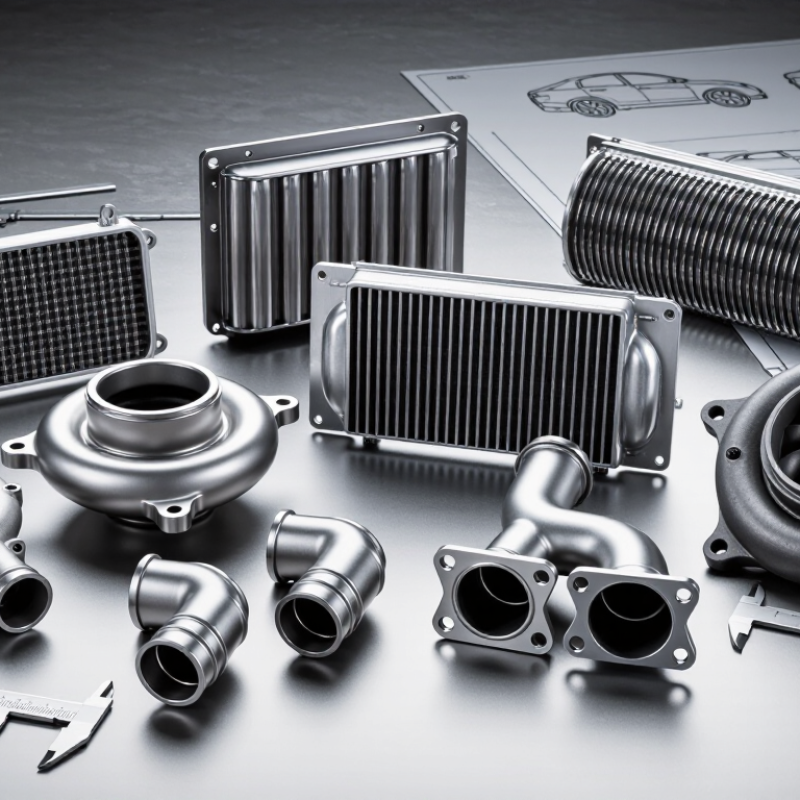
Turbo Intercooler Basics and Their Role in Engine Performance
A turbocharger compresses intake air, but compression also creates heat. Hot air is less dense and can increase combustion risks. An intercooler lowers this temperature before the air reaches the engine. Most units use an aluminum core, internal fins, and welded end tanks. The design must move heat efficiently without restricting airflow. A useful intercooler is not simply the largest available.
It must match the engine’s boost level, airflow demand, and installation space. Excessive pressure drop can weaken throttle response. Poor internal design may leave hot spots across the core. Workshop testing often compares inlet and outlet temperatures under repeated load, not only during one short pull. Reliable checks also include pressure testing, fin quality, weld consistency, and hose fitment. Small leaks matter. They can cause unstable boost and confusing diagnostic results. I have found that published cooling figures sometimes lack clear testing conditions, so buyers should question them. A lower outlet temperature does not always mean better performance. Airflow, response, durability, and corrosion resistance must be judged together. For global sourcing, clear drawings, material specifications, inspection records, and repeatable production standards provide stronger evidence than attractive product images. Even careful evaluations can miss real-world vibration or heat-soak problems. That limitation deserves attention.
Representative charge-air temperatures before and after intercooling at different boost-pressure levels.
Compressing air in a turbocharger raises its temperature and reduces its density. An intercooler lowers the charge-air temperature before it enters the engine, helping increase oxygen mass, reduce knock risk, and support more consistent power output. The density-gain estimates use the ideal-gas relationship at approximately constant pressure: density is inversely proportional to absolute temperature.
To select China’s top ten turbo intercooler suppliers for global buyers, we used a practical, evidence-based process. The review examined factory experience, engineering depth, production control, and export readiness. Public company information was checked against product details, facility images, technical documents, and buyer-facing records. We did not treat sales language as proof.
Technical evaluation focused on aluminum alloy selection, tube-and-fin or bar-and-plate construction, weld consistency, core dimensions, pressure ratings, and inlet design. Suppliers gained credibility when they could explain airflow targets, heat-transfer testing, leak testing, and dimensional inspection. We also considered drawing support, sample development, packaging, lead-time communication, and after-sales responses. These details matter when an intercooler must fit a modified engine bay, not just a catalog photograph. Strong suppliers showed repeatable processes rather than one impressive sample.
Reliability was assessed through documented quality systems, traceable inspection steps, and compliance support for different markets. We reviewed whether suppliers could provide material records, test reports, and clear tolerances without vague claims. Experience with overseas orders mattered, but it was not accepted blindly. No ranking is flawless. Factory conditions can change, and online evidence may remain incomplete. The method is useful, not perfect. Missing data was treated as a weakness, not an automatic failure, leaving room for buyer verification through samples, audits, and written specifications.
China’s ten leading turbo intercooler manufacturers show different strengths rather than identical production models. Two focus on bar-and-plate cores for heavy-duty engines. Three specialize in tube-and-fin designs for passenger vehicles. Others supply charge-air coolers, custom aluminum tanks, or low-volume racing parts. Several operate CNC machining, vacuum brazing, and pressure-testing lines in-house. This reduces handling risks.
MarketsandMarkets’ 2024 turbocharger market report indicates continued demand for efficient forced-induction systems, especially in commercial vehicles and industrial engines. The report also highlights lightweight materials and thermal management as key development areas. During supplier audits, buyers should check core dimensions, weld penetration, pressure-decay results, and salt-spray records. A polished surface means little without test evidence. I have seen excellent prototypes fail after repeated thermal cycling, which is an easy lesson to overlook.
Tips: Request three samples, not one. Compare pressure loss, cooling efficiency, weight, and fitment. Ask whether the factory controls fin density and alloy grades internally. The ten profiles should also be judged by response speed, engineering support, export experience, and corrective-action records. One manufacturer may offer the lowest quotation, while another provides better dimensional consistency across 1,000 units. That difference matters. ISO 9001 certification supports process discipline, but it does not replace independent inspection. Buyers should verify current certificates, production capacity, packaging protection, and documented performance at the intended airflow and boost pressure. Five minutes of paperwork can prevent months of field complaints.
China Top 10 Turbo Intercooler Suppliers for Global Buyers
Comparing Product Quality, Materials, Pricing, and Customization
A serious supplier comparison starts with test evidence, not catalog photographs. For the top Chinese turbo intercooler suppliers, buyers should request pressure-decay records, burst-pressure results, and airflow data at stated temperatures. These details expose weak welds and misleading performance claims. The 2024 MarketsandMarkets automotive turbocharger report forecasts strong global growth through 2029, increasing demand for stable charge-air cooling and repeatable production.
Material selection changes both performance and cost. Many suppliers use 3003 aluminum for cores because it balances formability and corrosion resistance. Some use 6061 aluminum for stronger tanks and mounting brackets. Bar-and-plate cores usually offer better durability, while tube-and-fin designs can reduce weight and price. Indicative export pricing often ranges from 80 to 450 US dollars, depending on size, testing, finish, and order volume. These figures are practical benchmarks, not fixed quotations.
Customization is where supplier capability becomes visible. Reliable factories can adjust inlet diameter, core thickness, bracket position, fin density, and surface coating. They should also provide dimensional reports under ISO 9001 or IATF 16949 systems. The Aluminum Association reports that recycling aluminum can save about 95% of the energy used for primary production, making material traceability increasingly relevant. Buyers should still inspect samples. Pricing comparisons remain imperfect when tooling, packaging, and validation fees are hidden. Small details matter.
| Supplier Profile | Typical Product Focus | Core Material | Welding / Finish | Typical Working Pressure | Estimated FOB Price | Typical MOQ | Sample Lead Time | Customization Capability | Quality Position |
|---|---|---|---|---|---|---|---|---|---|
| Supplier Profile 01 | Bar-and-plate performance intercoolers | 6061 aluminum alloy | TIG welded; polished or black powder-coated end tanks | 2.0–3.0 bar | US$85–180 | 10–30 units | 15–25 days | Core dimensions, inlet/outlet positions, brackets, logo-free packaging | High |
| Supplier Profile 02 | Tube-and-fin intercoolers for passenger cars | 3003 aluminum alloy tubes and fins | Controlled furnace brazing; mill finish | 1.5–2.2 bar | US$45–105 | 50–100 units | 20–30 days | Fin density, core height, mounting tabs, pipe diameter | Medium–High |
| Supplier Profile 03 | Heavy-duty and commercial-vehicle charge-air coolers | Aluminum alloy core with reinforced tanks | Robotic brazing; corrosion-resistant coating | 2.0–3.5 bar | US$160–420 | 5–20 units | 25–40 days | Large-core design, heavy-duty brackets, pressure-port configuration | High |
| Supplier Profile 04 | Universal aftermarket intercooler kits | Bar-and-plate aluminum alloy | TIG welded; anodized or powder-coated finish | 2.0–2.8 bar | US$70–150 | 20–50 units | 18–28 days | Universal dimensions, silicone couplers, piping kits, bracket sets | Medium–High |
| Supplier Profile 05 | Compact intercoolers for small-displacement turbo engines | 3003 aluminum alloy with cast end tanks | Vacuum brazing; black or natural finish | 1.2–2.0 bar | US$38–85 | 100–300 units | 25–35 days | Compact packaging, inlet diameter, sensor ports, mounting points | Medium |
| Supplier Profile 06 | Motorsport and high-boost applications | 6061-T6 aluminum alloy | Precision TIG welding; CNC-machined tanks | 2.5–4.0 bar | US$180–480 | 1–10 units | 30–45 days | CAD-based geometry, internal fin design, tanks, ports, brackets | Premium |
| Supplier Profile 07 | Replacement intercoolers for passenger vehicles | Aluminum core with stamped alloy tanks | Brazed construction; epoxy-coated surface | 1.5–2.5 bar | US$55–125 | 50–150 units | 25–35 days | OE-style dimensions, mounting points, hose connections, packaging | Medium–High |
| Supplier Profile 08 | Low-volume prototype and development units | 6061 aluminum alloy; optional stainless fittings | Manual TIG welding; bead-blasted finish | 1.5–3.0 bar | US$220–650 | 1–5 units | 10–20 days | Rapid CAD revision, prototype tooling, one-off dimensions and fittings | High |
| Supplier Profile 09 | Private-label and export-oriented product lines | Bar-and-plate aluminum alloy | Automated TIG welding; powder coating available | 1.8–3.0 bar | US$65–145 | 100–500 units | 30–45 days | Retail packaging, barcode labels, instruction sheets, standard tooling changes | Medium–High |
| Supplier Profile 10 | Industrial, agricultural, and special-purpose turbo systems | Aluminum alloy core with reinforced steel brackets | Brazed core; anti-corrosion coating and pressure testing | 2.0–3.5 bar | US$140–360 | 5–25 units | 30–50 days | Custom brackets, non-standard ports, vibration-resistant construction | High |
Notes: Actual specifications should be confirmed through drawings, material certificates, dimensional inspection, leak testing, pressure testing, and a production sample before purchase. Working-pressure figures are application ranges, not universal safety ratings.
When evaluating China’s top turbo intercooler suppliers, global buyers should examine evidence, not polished catalogs. Request engineering drawings, alloy specifications, pressure ratings, and recent leak-test records. Ask whether each batch receives dimensional and pressure inspection. Numbers need context.
Order samples before discussing large volumes. Check fin alignment, weld consistency, port dimensions, surface finish, and packaging strength. Test the sample. Compare airflow, pressure drop, and heat-transfer results under the same conditions. A supplier should explain its test equipment and calibration process clearly. Factory audits can verify production capacity, traceability, worker training, and quality controls. Photos alone are weak evidence.
Pricing also needs careful review. Confirm minimum order quantities, tooling ownership, lead times, payment terms, shipping responsibilities, and replacement procedures. Request a written specification sheet before final approval. Keep records. Communication speed matters, but technical accuracy matters more. One limitation remains: a successful sample cannot guarantee stable mass production. Buyers should inspect early production batches and define corrective actions in the purchase agreement. A lower quote may hide thinner materials, weaker packaging, or inconsistent inspection. Allow room for doubt.